
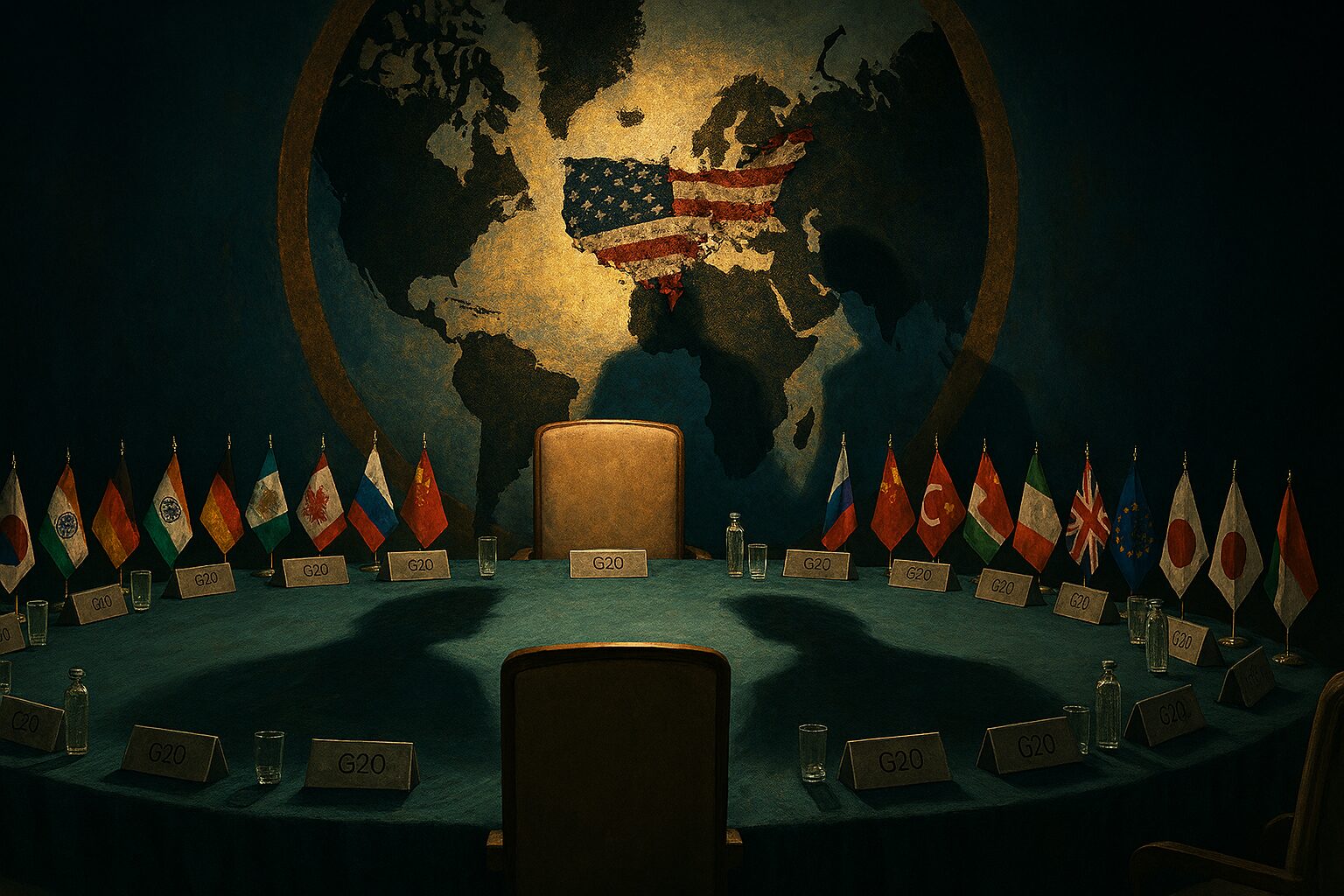
The Trump Administration's unilateral foreign policy is abandoning global leadership, empowering rivals and undermines institutions.
Abandoning Global Leadership
The stability of the post-World War II global order rests on a bedrock of international cooperation, diplomacy, and the consistent engagement of its leading powers. Today, that foundation is cracking under the weight of an "America First" doctrine that appears to prize isolation over influence. The current administration's foreign policy is actively resulting in the United States Abandoning Global Leadership, leaving a power vacuum that strategic rivals like China and Russia are eagerly filling. A series of recent diplomatic missteps—from an overtly biased "peace plan" for Ukraine to the outright boycott of the G20 Summit—do not reflect a principled new strategy, but rather a dangerous capitulation of American authority on the world stage.
The Policy Retreat: A Summary of Controversies
The perceived decline of the U.S. position is not the result of a single event but a pattern of de-prioritizing long-standing alliances and multilateral frameworks.
Policy Summary
The recent controversies involve three critical geopolitical flashpoints and institutional norms:
- China and Taiwan: While the U.S. has traditionally maintained a policy of "strategic ambiguity," recent Chinese diplomatic communiqués suggest Beijing views the Trump administration's posture as overly accommodating. Chinese leader Xi Jinping has reportedly framed Taiwan's "return to China" as an integral part of the post-war international order in discussions with the administration, a framing the U.S. has failed to publicly and forcefully push back against in a unified manner.1 This rhetoric, coupled with what is interpreted as transactional diplomacy, allows Beijing to advance its territorial claims and influence the narrative, particularly in its diplomatic spat with U.S. allies like Japan.
- Russia and Ukraine: The administration's proposed 28-point "peace plan" for ending the conflict in Ukraine, reportedly drafted with Russian input, has been widely criticized by European allies and Kyiv as a blueprint for Ukrainian surrender.2 The plan's provisions reportedly call for Ukraine to cede significant territory, limit the size of its military, and commit to not joining NATO—maximalist demands long sought by the Kremlin.3 Ukraine has publicly stated it has significant amendments to the proposal, illustrating the plan’s fundamental failure to respect Ukrainian sovereignty and territorial integrity.4
- The G20 Summit: The decision by the administration to boycott the G20 Summit in Johannesburg—a key forum for the world's largest economies to coordinate on finance, climate, and development—was interpreted globally as a deliberate insult to the host nation, South Africa, and a profound retreat from multilateralism.5 This absence, explained by the administration as a protest of the host's focus on the Global South, only served to weaken U.S. influence and empower other actors, notably China, to shape the economic agenda.6
Opposing Arguments
Proponents of the administration's foreign policy argue that these actions are not a retreat but a necessary recalibration based on "realpolitik."
- On China and Taiwan: Supporters argue the goal is to stabilize the relationship, avoid direct confrontation, and gain trade concessions, suggesting that strong, transactional diplomacy is more effective than the status quo of endless engagement.
- On Russia and Ukraine: The argument is that the peace plan, while harsh, is a realistic attempt to halt a devastating war that is draining Western resources, prioritizing an end to bloodshed over a military victory that may be unattainable.
- On the G20: The administration has dismissed the G20 as an inefficient "talk shop" that does not advance American interests. They contend that bypassing such forums frees the U.S. to pursue its goals unilaterally and bilaterally, saving time and resources that would otherwise be spent on consensus-building.
Core Analysis and Rebuttal: The Threat of Isolationism
From a Progressive perspective rooted in institutionalism and human rights, the administration’s transactional approach is deeply misguided. It mistakes isolation for strength and unilateralism for efficacy, fundamentally Abandoning Global Leadership precisely when coordinated global action is most needed.7
The Progressive Case Against Abandoning Global Leadership
The Progressive worldview champions the rules-based international order because it protects the most vulnerable, fosters stability, and provides a platform for tackling global challenges like climate change and economic inequality.
The administration’s actions systematically undermine this order:
- Empowering Authoritarianism: The Russia-Ukraine "peace plan" is a clear example of prioritizing a short-term diplomatic headline over democratic principles. By implicitly endorsing the transfer of sovereign Ukrainian territory to an aggressor and effectively granting Russia a veto over Ukraine’s NATO future, the U.S. sends a message to autocracies worldwide: aggression is rewarded, and international law is optional.8 This directly contradicts the long-standing Progressive commitment to self-determination and the principle that borders cannot be changed by force.9
- China’s Diplomatic Victory: In its dealings with China, the administration has been outmaneuvered. By focusing almost exclusively on trade deals, the U.S. has allowed Beijing to pivot discussions toward its core political claims, such as Taiwan. When the Chinese Foreign Ministry can frame a conversation with the U.S. President as a win for its historical claim over Taiwan, it is a diplomatic catastrophe. The lack of unified resistance degrades U.S. credibility among Asian allies, who now question America’s commitment to regional security.
- Surrendering the Economic Stage: The boycott of the G20 Summit was a self-inflicted wound. The G20 is the premier venue for addressing critical Global South issues, including debt restructuring and climate finance—issues central to a Progressive foreign policy agenda. By walking away, the U.S. ceded the microphone to rivals, allowing China to position itself as the champion of the developing world and reinforcing a narrative that the U.S. cares only for its narrow domestic concerns. The notion that the U.S. can effectively dictate global terms from the outside is an illusion; real influence is found at the negotiating table, shaping the declaration and building coalitions.
This policy is not just ineffective; it is fundamentally reckless. It is based on the false premise that retreating from institutions makes America "freer."10 In reality, by weakening the United Nations, the World Trade Organization, and multilateral forums like the G20, the U.S. merely reduces the global guardrails that keep great power competition in check. It allows the most powerful actors—including non-democratic ones—to operate without collective constraint.
Conclusion
The current administration is trading decades of hard-won U.S. global influence for fleeting, transactional wins. The consistent pattern of unilateralism in Ukraine, equivocation on Taiwan, and diplomatic absence at the G20 illustrates a foreign policy of retreat. The true cost of Abandoning Global Leadership is not merely diminished status; it is a world that is less stable, less democratic, and less capable of addressing the existential threats of climate change and economic inequality.
The path forward requires a decisive return to multilateral engagement, diplomatic integrity, and the unambiguous defense of international norms. The United States must rebuild its alliances, recommit to the institutions it helped create, and stand unequivocally on the side of sovereignty, democracy, and human rights.
Sources
- Reckless Peacemaker? US Views on Trump's Foreign Policy, 2025 - Institute for Global Affairs
- The G20 without the US: multilateralism after hegemony? - Real Instituto Elcano
- Here's what's in the Trump administration's proposed 28-point Russia-Ukraine peace plan - CBS News
- China sees Trump calls as a win in spat with Japan over Taiwan - The Washington Post
- Trump's Attacks on Multilateralism Make America Weaker, Not Stronger - Center for American Progress

The engine of this page is a fusion of the author's singular voice, relentless passion for their subject, and the structured analytical support of Web-based AI. Every article is driven by a powerful editorial stance, a conviction the writer is ready to defend or advocate for. This collaboration ensures the final opinion is anchored in both the emotional resonance of a genuine perspective and the analytical clarity necessary to establish authority and drive public discourse.